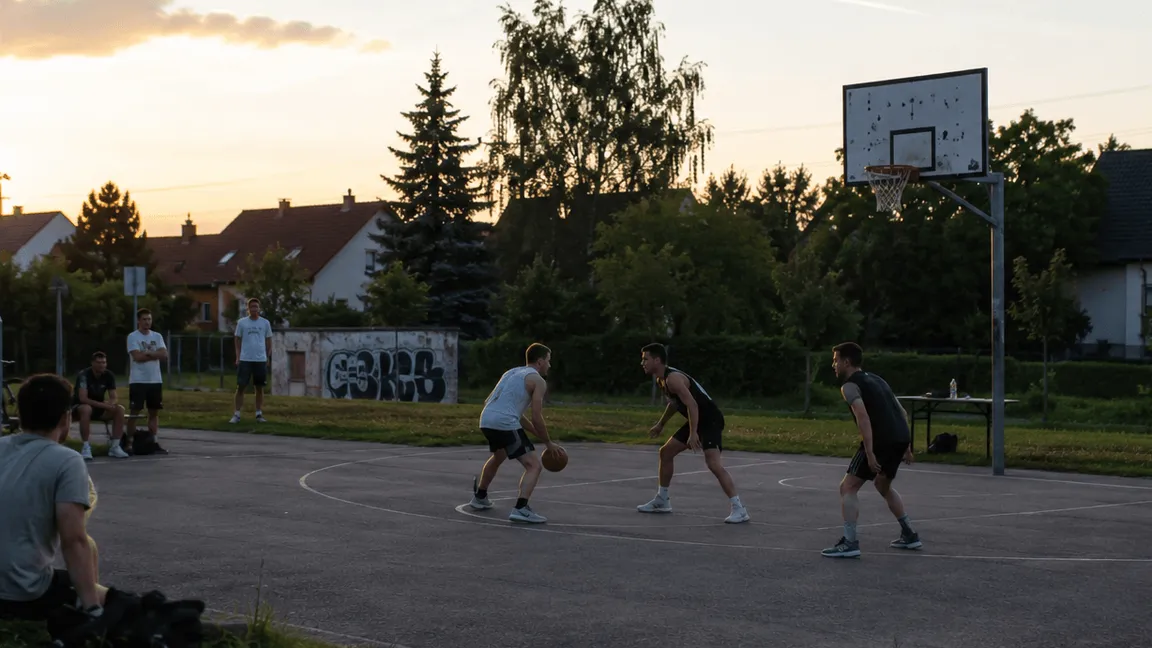
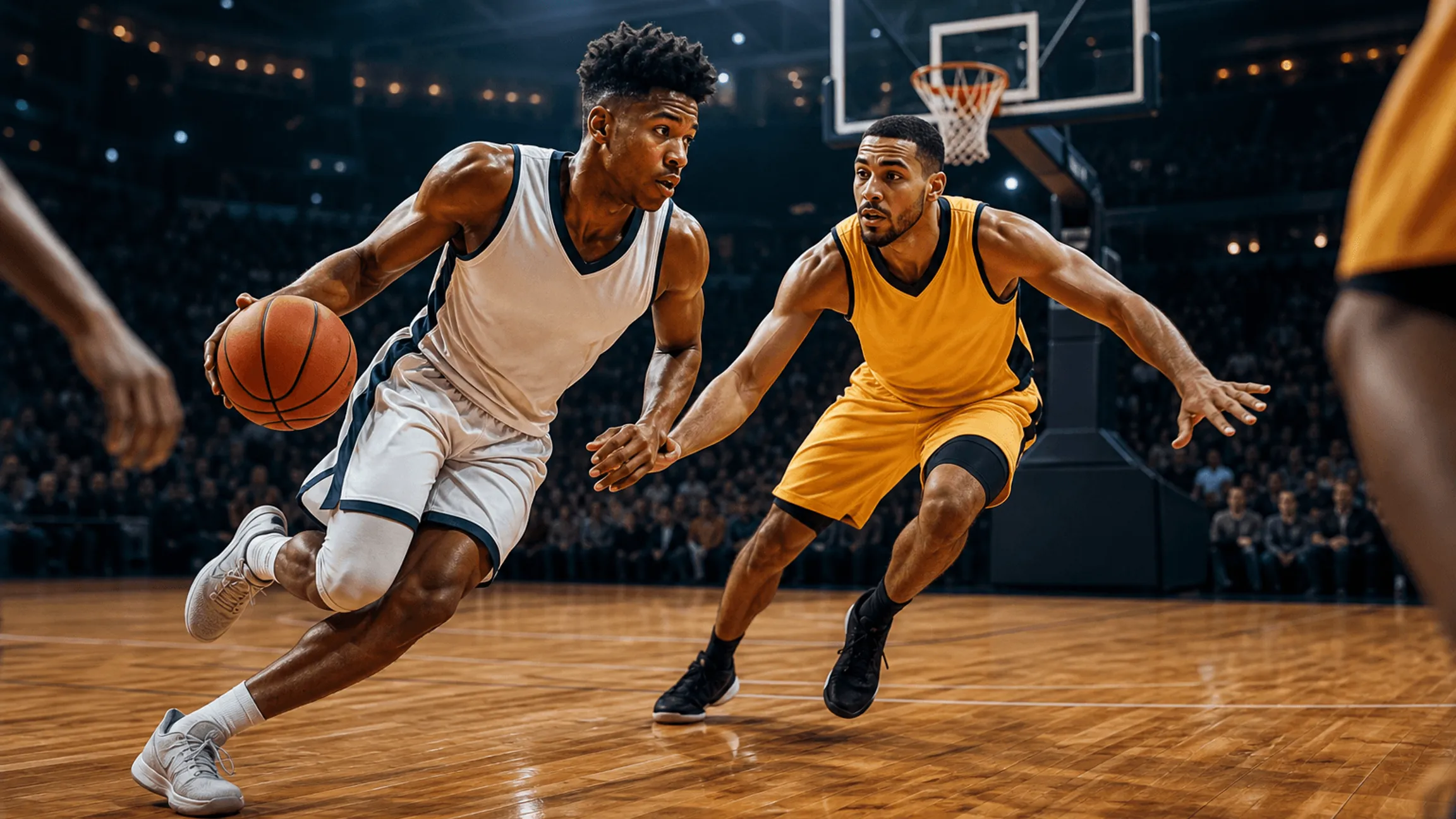
Basketball is one of the most popular sports in the U.S. and is also played relatively often in clubs in Germany. The main reason for this is that, aside from indoor shoes, you don’t really need any special equipment to play. The fast pace of the game also leads to a lot of scoring and, consequently, plenty of action. However, because the sport is played worldwide, the rules can vary slightly from country to country. In this article, I’ll focus mainly on the rules in the German basketball leagues, but I’ll also mention the most important differences from the American professional league (NBA).
The Court
Basketball is usually played indoors on a rectangular court. It is bounded by the end lines at both ends of the court and the sidelines. At both ends, there is also a 3.05-meter-high basket mounted on a backboard, through which points can be scored. Directly below this basket is the so-called no-charging semicircle, as well as the key, including the free-throw line, the significance of which I’ll explain later. Outside the key is the three-point line; if an offensive player shoots from behind this line toward the basket, they can score 3 points instead of 2.

Source: https://www.sportscourtdimensions.com/basketball/
The Players
Each team has 5 active players on the court and may have an active roster of 12 players. Although each of these 5 players in basketball serves both on offense and defense and therefore has more or less the same tasks (scoring points and preventing the opponent from scoring), these players are assigned different roles or positions. The following five positions are usually represented on a basketball team.
The team’s playmaker is the so-called point guard. He calls the plays and brings the ball into the opponent’s half during offense. He is quite the all-around player—while he must be particularly skilled at dribbling and should be able to make accurate passes, he also frequently scores points himself in suitable situations with the help of his teammates.
For the point guard, the so-called shooting guard is one of the primary passing targets. The shooting guard is known in particular for his accuracy on outside shots, but can also take on the role of the point guard in certain situations.
In addition to the shooting guard, the small forward is also used for long-range attacks, but is usually even more athletic than the shooting guard and can therefore also score by driving directly to the basket.
In addition to these three generally smaller and faster players, there are two more powerful players who score primarily due to their size. The Power Forward is tasked with operating between the paint and the three-point line and clearing a path to the basket for the faster players through so-called blocks (also called picks or screens) to clear the way to the basket for the faster players. However, thanks to his athleticism, he can also score himself, especially right under the basket. The second of these larger and stronger players is the Center. The center typically positions himself directly under the basket to receive passes and uses his strength and size to score points right there.
As a rule, each player also defends the opposing player in the same position (man-to-man defense). However, there is also what is known as zone defense, in which the defensive players are spread out across the zone and defend the opposing player who is closest to them.
The Basic Rules
The game is played in four quarters of 10 minutes each (12 minutes in the NBA). If there is no winner after the final quarter, 5-minute overtime periods are played until a winner is determined. There is a 2-minute break between quarters and each overtime period, and after the second quarter (at halftime), there is a 10–15-minute break, depending on the league. If the referee stops play, the clock is paused; thus, only the actual playing time is counted toward the length of a quarter.
To move the ball, it must be dribbled—that is, tapped repeatedly on the floor. After dribbling, the player in possession of the ball may make two more foot contacts with the floor. To do so, however, the player must be in motion, as these two contacts (one for each foot) have already been made while standing still. The leg with which the ball handler last made contact with the floor in accordance with the rules is called the supporting leg. As long as this leg remains firmly on the ground, the player may move the other leg freely on the ground (star step). Once a player has stopped dribbling (which is considered to have occurred as soon as a hand is placed under the ball), they may not dribble again. This violation is called double dribble . Furthermore, no player may intentionally play the ball with their foot. If a team violates any of the aforementioned rules, possession of the ball transfers to the opposing team.
The offensive team has 24 seconds to mount an attack. These 24 seconds are reset if the ball touches the rim, an opposing player plays the ball with their foot (in which case the clock is reset to a maximum of 14 seconds), or possession of the ball passes to the opposing team. The attacking team must bring the ball into the opponent’s half within 8 seconds; furthermore, the ball may not be passed or carried back from the opponent’s half into the team’s own half (backpass). Furthermore, an attacking player may remain in the opponent’s zone for no more than 3 seconds (even without possession of the ball) and may not hold the ball in their hands for longer than 5 seconds without taking an action (dribbling, shooting, passing). This 5-second rule also applies to a throw-in from outside the court, which is taken by a team when a player from the opposing team is in possession of the ball outside the baseline or sideline, or when the ball touches the floor outside these lines. If the attacking team violates one of these time rules, possession of the ball changes.
Another rule that is more relevant in higher leagues is the so-called goaltending. This rule states that the defending team may not touch the ball once the attacking team has attempted a shot, provided the ball is in its downward trajectory or has already touched the backboard behind the basket and there is a possibility that the ball will still enter the basket. A violation of this rule is penalized by awarding a basket to the offensive team.
Of course, in basketball there are also fouls committed against other players. A distinction is made between personal (technical), unsportsmanlike, and disqualifying fouls. Personal fouls apply to individual players (including the coach) and are called when a player holds, shoves, runs into, or otherwise (often unintentionally) makes physical contact with an opponent. Complaining (often by the coach) or distracting an opponent while shooting through gestures and facial expressions is also considered a personal foul. If a player has committed 5 personal fouls in a game, that player may no longer participate in the current game. Two technical or personal fouls against the coach, or one technical foul against the coach and two against players on the bench—or even three against players on the bench—result in the coach’s disqualification. If the physical contact is intentional and very hard, an unsportsmanlike foul may be called against the player. If, on the other hand, the player intentionally risks causing a serious injury to the opponent during the foul or displays extremely gross unsportsmanlike conduct, a disqualifying foul may also be called against the player. Two unsportsmanlike fouls or one disqualifying foul by a player results in that player’s disqualification from the current game. If a player is fouled while attempting a shot, he is awarded a certain number of free throws (see next section). A foul without a shot attempt results in a throw-in for the team in possession of the ball at the sideline, unless more than 4 fouls have already been called against the fouling team in the current quarter. In that case, the fouled player is awarded two free throws. More detailed rules regarding fouls in basketball can be found here .
Scoring Points
If the offensive team scores a basket from inside the three-point line during normal play, it is worth 2 points; from outside the three-point line, it is worth 3 points. If a player is fouled while attempting a shot, that player is awarded two free throws from the free-throw line, or three free throws if the shot attempt was made from outside the three-point line. If the shot is successful despite the foul, the points from the shot count, and the shooter is awarded one or two (for a shot from outside the three-point line) free throws.
The Start of the Game
A basketball game begins with a jump ball. A referee tosses the ball upward at the center line between two opposing players. The two opposing players attempt to get the ball to their teammates. The team that gains possession of the ball from this jump ball may immediately begin its offense. In the subsequent quarters, possession of the ball alternates between the two teams.
Conclusion
There are many different variations of basketball. Particularly popular is streetball. This is often played 3-on-3 with only one basket and modified rules. The basics described in this article refer to standard 5-on-5 basketball played with two baskets.
I hope we’ve helped you understand the most important basics of this sport and that you’ll give it a try for yourself. If you like it, I especially recommend the Landsberg Streetball Tournament is highly recommended for competing against other players in this sport.